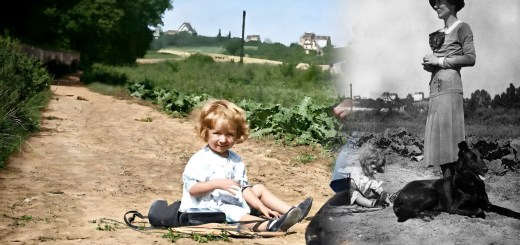
1929 June 14 | Tea Set in a Mayaliwa Evening
Then – The first camp
The truck has turned at the end of the dirt track and dived straight back into the sea of grass. The chugging, backfiring engine and the grinding gears are snuffed out of existence, switched off by an offscreen sound engineer. Mercilessly swallowed by the viridian wall. Somewhere over there, in the bright green swaying grass blades, the life line to 1929 trundles and shakes back to the station.
5 days until the next pick-up and move, on to the next camp for her, the next assignment for him. A trial period of sort.
The truck is gone, and so are the Watchers in the Reeds, as she nicknamed them already. Their traditional trick of popping up out of the grass, transfixed by the activity, done, vanishing again as soon as the show was over. François is off with the village chief, their voices gradually muffled by the huts. The voices mix French, the language of the Bula Matari, the big bosses, and Kiswahili. Something about the number of men, the tasks, … Probably also where to shoot what …
The chief had lent them a nice shaded spot just at the edge of the village and two of his “sons” for the domestic help, as was customary.
The boys are quietly working on the evening dinner already, well-groomed in clean shirts and shorts. If without shoes. That’s normal, she had been told. Polite, inquisitive, alert, they are instructed to observe and learn. After all, it is not every day that you see Mundele so far into the hills of Fizi territory. The sons have set the brand-new crackling tent under an hour, a minor miracle. Oh, it is no Barnum, but a comfortable enough canopy; you can actually walk into this one-room apartment. The spot they were allocated is just out of the wind, after the last hut, under an old Dombeya tree. The leaves that started falling just blend it more with the lush green all around. Scenic.
The wind picks up, rustling the leaves, swaying the palms, whistling in the grass. Birds and bees get accustomed to their presence. Suzanne scans her spot.
Someone laughs in the village, some kids chase each other. Two women pass by, chatting, on their way to fetch water. Life breathes again.
Everything here seems to have several lives in them: branches cut to create the tent become a basic table, or a wall, an oil can a stool, another a cooking pot; wooden crates become cupboards. Nothing gets lost. Shocking and obvious.
Curiouser and curiouser.
Time to organise time and the space! Since leaving Brussels, on the boats, they have of course used the big trunk with Baraka and UMHK written on it in thick white paint. They have used the hat boxes and the smaller suitcases. But the crates of the wedding gifts and the Comptoir Congolais! Unpacking these, that is when Suzanne truly feels that she has arrived! There is a before and after these crates, overflowing with promise.
All of it hers. Well, theirs. But mostly hers though.
The kitchen towels, the mugs, the plates, the cutlery, the pans, the pots, the taller pots, the coffee pots, the teapots, the porcelain cups, the sauce jug, …. Wait, the sauce jug?? Oh well, appearances are everything, is it not? You can be in the middle of the jungle, but it is no reason to let standards down, she laughs to herself. And on it goes, opened, unwrapped, and piled on and on until every centimetre of every surface is covered in cutlery, kitchen apparels and tools.
A Mad Hatter kitchen set.
Oh well, she mugs at herself, as she remembers each an everyone of her choices at the Congo store, Parys’, and snickers at the camping book they thought would be crucial. She could see it would never be opened in the decades to come. And the “professional” wooden tent pegs? They would probably better soak up the rain. And … a sauce jug. Of course. François is walking back from his palabre with the Chief and smiles broadly. She grins, sprawling among the crockery, a cat showing off its prey. Click.
Tomorrow the official reception dinner, but tonight canned beef and beans, “à la Mayaliwa”. Both laugh.
17h45, the birds explode in songs among the tropical trees, screeching debriefings of a day full of surprises.
18h05: night. Like every day for the coming year. But this one, the first one. The lamps start hissing. They talk in a low voice that still resonates throughout the village.
Other voices drop. Conversations falter. In the distance, the narration of a griot. The voïd glints. They snuff out the storm lamps.
People walk furtively nearby. A fishing owl starts moaning. The canvas clacks. The camp bed creaks.
What to do now with whatever she packed that looks… irrelevant now?
Something he read in an English book would make her smile.
-.-
A bright idea came in her head. “Is that the reason so many tea-things are put out here?” asked Alice. “Yes, that’s it,” said the Hatter with a sigh: “it’s always tea-time…”
Now – Under the tent awning, in the primordial forest
One step back. And another. Soon, there is none left. The shoulders bend on their own, arms wrapped around the chest, head down. An animal reflex to bear out a primeval weather. The rain has been streaming off the canvas in wide sheets. It has no time to lose, no time to drip, the sheets are an eternity rushing in a bow-wave: off to the river! On to the sea! It foams out of buckets, out of tanks, out of pools, desperate to snatch back the weeks and months lost snaking around the hills, beaten by the sledgehammer of the Sun.
I’m late, I’m late for a very important date. No time to say hello! I shall see you at the sea.
Under the awning, the patch of red dust shrinks and turns brown. The familiar dirt turns to treacherous mud. Nature sidles its way inside, snaking itself back into what belongs to it, forever. It slowly, inexorably reclaims the patch it lost to the tent. And, if that is not enough, just to make a point, a sudden gust of wind will shower cold water inside. No cheating, no stealing! The foaming clouds grumble, roar, and the violent rain redoubles.
You stand under the sky, on the water divide between East and Central Africa. The rain will become the Congo and rush into the Atlantic.
It is not even a storm. It just rains. Tropical rain. Primeval rain.
Will it ever stop? How long is forever? Sometimes, just one second.
You read part 7 of Transvaal Blue Skies: the true story of how, early last century, Suzanne moved to Africa and built her laager. This is a series of loose dots weaved in a chronological thread, wrapped into a story to be plucked and observed, heard and remembered, recognised and judged. Suzanne Dulière was my grandmother.
Follow on Facebook, Instagram and TikTok
Discover more from Pascal Bollon
Subscribe to get the latest posts sent to your email.